Posts

Showing posts with the label Multi-Cloud

This Week I Learned - Week #43 2023
Image
This Week I Learned -  * MySQL HeatWave is a massively parallel, high performance, in-memory query accelerator that accelerates MySQL performance by orders of magnitude for analytics and mixed workloads. MySQL HeatWave on AWS is a fully managed  service that can help you create and manage a MySQL DB System with a HeatWave Cluster to use with AWS Applications. * Device42 Warranty Sync feature allows customers to take the discovered hardware devices in their environment and sync into Device42 the warranty and support contract information.  This helps in understanding which hardware is in support, what is coming up for expiration, and what devices are out of support all in one simple report.  You can also use this information to create automated email reports to alert you when hardware is coming up on expiration so you can take action to renew it or move off of that hardware platform. Device42 supports most major manufacturers like Dell, Lenovo, HP, IBM, and Meraki. *...

This Week I Learned - Week #48 2022

Image
This Week I Learned -  * Too much choice can cause indecision and delay. Multiple contractors in your house simultaneously doing home improvement can create a lot of complexity and coordination for you to manage. The same dynamics exist for multicloud. Some companies choose to be multicloud because they’ve adopt a best-of-breed approach, selecting certain providers for the tasks at which their technology excels. Some companies become multicloud for regional or compliance needs while some find themselves in a multicloud situation because of mergers and acquisitions that bring other clouds into their portfolio. - Do’s and don’ts of a successful multicloud strategy   * Modern hypervisors are pretty efficient. VMware reports hypervisor overhead rates of just 2 percent compared to bare metal [ PDF ] *  When running Kubernetes on VMs instead of bare-metal, virtualization is going to reduce total resource availability for your pods by about 10% to 20% . When you run your no...

What's the difference between Multi-Cloud and Hybrid Cloud

Image
Multi‑cloud and hybrid‑cloud are often used synonymously, but there is in fact a difference. Various perspectives & explanations - Microsoft - A hybrid cloud is a type of cloud computing that combines a private cloud (on-premises infrastructure), with a public cloud (computing services offered by third-party providers over the public internet). The hybrid cloud is evolving to include edge workloads. Multicloud computing refers to the use of multiple cloud computing services from more than one cloud provider (including private and public clouds), in a heterogeneous environment .  Google - Within the context of Google Cloud, the term hybrid cloud describes a setup in which common or interconnected workloads are deployed across multiple computing environments, one based in the public cloud, and at least one being private.  The term multi-cloud describes setups that combine at least two public cloud providers, as in the following diagram. A multi-cloud setup...

Oracle Cloud Infrastructure (OCI) vs popular Public Cloud Platforms

Key differentiators according to Oracle on how OCI is better than Amazon Web Services (AWS) , Microsoft Azure , and Google Cloud Platform (GCP) - Pricing Predictability - Same pricing worldwide across 36 cloud regions in 19 countries (as of Feb 2022) Lowest TCO for Oracle Database and applications - Oracle Bring Your Own License (BYOL) is 50% less on OCI than any other public cloud, including Azure. Oracle offers Universal Credits and BYOL2PaaS to help customers bring their existing Oracle software licenses to OCI. Cloud Service Providers (CSPs) don’t support Oracle technology in the same way. High-performance Oracle workloads, large Oracle databases and a wider portfolio of Oracle DBaaS are all better supported by OCI than other CSPs.  As a rule of thumb , organizations may require double licenses for the same computing capabilities related to the number of core processors to enable the same Oracle product on other CSPs, compared with OCI. Fully supported advanced data...

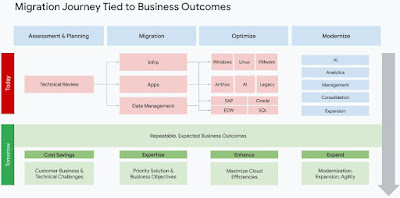
"CIO's Guide to Application Migration" - Key points

Image
Key points from  CIO's Guide to Application Migration  (Google Cloud Whitepaper, May 2020) - A well-designed digital transformation strategy should do much more than keep you competitive...instead, it should position you to excel by untethering IT staff from low value, labor-intensive tasks, allowing them to focus on innovation and high-impact projects.  Digital transformation is truly an exercise in change management, requiring determined effort and focused leadership across people, process and technology domains; it is as much a culture shift as a technology revamp.  While some licenses allow you to deploy an application in a cloud environment, others explicitly forbid cloud deployment. In addition, some licenses (like for Oracle software) are assigned based on the number of CPUs or sockets in use, and these concepts might not be applicable when running on cloud technology. If retention on-premises is no longer viable  (e.g. if you must completely shut down y...

Google debunks Myths about Multicloud

Image
Google debunks myths about Multicloud in the white paper 5 ways Google can help you succeed in the multicloud world (PDF, May 2021): Myth #1: Multicloud is expensive  Reality: Managed strategically, multicloud can give you the flexibility you need to lower your overall IT costs. An all-in one cloud approach means you are locked into the features and services of one vendor for multiple years. Operating in multiple clouds lets you choose the most cost effective solution for your business and leverage providers against each other to get the best price. Myth #2: Most organizations are all in one cloud Reality: According to research from Gartner, a majority of enterprises are currently hybrid in nature with plans to move to more than one cloud in the future.  Myth #3: You can’t have speed and reliability in multicloud Reality: With the combined strength of Google Cloud’s easy to use developer tools and advanced monitoring across environments with Apigee and the operations suite yo...

This Week I Learned - Week #24 2021

Image
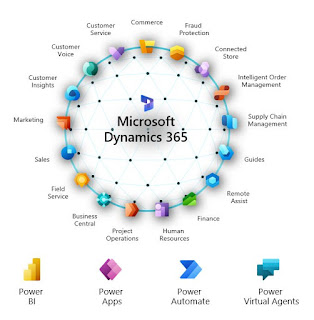
This Week I Learned -  * Microsoft Power Platform consists of Power Apps, Power Automate (formerly Flow), Power BI, and Power Virtual Agents Microsoft Power Platform provides a suite of capabilities for Dynamics 365 applications via the Power Platform Admin Center. *  Azure Stack, AWS Outposts and Google Anthos aim to integrate on-premises resources with the public cloud services on Azure, AWS and Google Cloud Platform (GCP), respectively .  Organizations can use the on-premises hardware they already own to build a hybrid cloud with Anthos, or they can purchase inexpensive commodity servers. Google offers the most flexibility with hardware choices, while AWS offers the least. Azure Stack and Outposts are  not  multi-cloud products. They only work with their respective clouds -- Azure or AWS -- and IT teams cannot integrate them with other public clouds.  * Microsoft bought Github in 2018.  For hosting code repositories , nothing comes close t...

This Week I Learned - Week #22 2021

Image
This Week I Learned -  * A custom connector is a wrapper around a REST API (Logic Apps also supports SOAP APIs) that allows Logic Apps, Power Automate, or Power Apps to communicate with that REST or SOAP API. Once you have an API with authenticated access, you can describe your API using OpenAPI definitions and Postman collections so that Logic Apps, Power Automate, or Power Apps can communicate with your API.  If you'd like to share your connector with all users of Logic Apps, Power Automate, and Power Apps, you can submit your connector for Microsoft certification . *  Google Cloud Certification - Professional Cloud Architect prep material *  Cisco's perspective on multi-cloud   - As the adoption of multicloud has increased, so has the potential for evolution to cloud-native operating models and the transformation in IT capabilities delivered by such an evolution. That transformation, in turn, helps enable agility and responsiveness for the business...

This Week I Learned - Week #20 2021

Image
This Week I Learned -  * Multi-cloud refers to the use of two or more cloud computing systems at the same time. The deployment might use public clouds, private clouds, or some combination of the two. Multi-cloud deployments aim to offer redundancy in case of hardware/software failures and avoid vendor lock-in. A lot of enterprises call their virtualized environments private clouds, whether these are hosted in external datacenters or in self-owned, on premises datacenters. Merely combining solutions and services from different cloud providers and/or private clouds do not represent a true multi-cloud approach. There are different opinions on the definitions of hybrid IT and multi-cloud. One is that hybrid platforms are homogenous and multi-cloud are heterogenous. Homogenous meaning that the cloud solutions belong to one stack, for instance Azure public with Azure Stack on premises. Heterogenous then would be for instance combining Azure and AWS. Multi-cloud is a true mixed ...