* Anthropic’s Claude 3 models are now available in Google Cloud Vertex AI. The Claude 3 family joins over 130 models already available in Vertex AI Model Garden. Claude models are offered in Vertex AI as managed APIs — meaning customers can concentrate on building groundbreaking applications instead of worrying about backend complexity or the management overhead of underlying infrastructure.
* All Claude 3 models boast improved fluency in non-English languages, as well as vision capabilities that unlock tasks ranging from image metadata generation to insights extraction across PDFs, flow charts, and a diverse range of other formats.
* The New Stack Better, Faster, Stronger: How Generative AI Transforms Software DevelopmenteBook (2024, 45 pages) by Janakiram MSV
* Cassie Kozyrkov on current state of AI - "The truth is, no one knows exactly where we're headed. We are building the plane while it's taking off. Which is why it's worth reminding people to zoom out and focus on the problem they're trying to solve. Don't get too attached to the tools you're using to solve a problem. Focus on developing clear thinking, precise expression, good taste for design, and an insatiable hunger for the bigger picture."
* Nvidia CEO Jensen Huang’s advice to Stanford students - "People with very high expectations have very low resilience and unfortunately resilience matters in success. I don't know how to teach it to you except for I hope suffering happens to you. I was fortunate that I grew up with it with my parents providing a condition for us to be successful on the one hand but there were plenty of opportunities for setbacks and suffering and to this day I use the word the phrase pain and suffering inside our company with great glee...I mean that in a happy way because you want to train...you want to refine the character of your company...you want greatness...Greatness comes from character and character isn't formed out of smart people. It's formed out of people who suffered...and so if I could wish upon you, I don't know how to do it for all of you Stanford students...I wish upon you ample doses of pain and suffering."
* The official language of Indonesia is Indonesian, locally known as Bahasa Indonesia, which serves as the lingua franca of the nation. Despite the prevalence of Indonesian, there are numerous local languages and dialects spoken across different regions of Indonesia. Some of the distinctly different local languages include Acehnese, Batak, Sundanese, Javanese, Sasak, Tetum of Timor, Dayak, Minahasa, Toraja, Buginese, and Halmahera
* In physics and geometry, a catenary is the curve that an idealized hanging chain or cable assumes under its own weight when supported only at its ends in a uniform gravitational field. The catenary curve has a U-like shape, superficially similar in appearance to a parabola, which it is not. Catenaries and related curves are used in architecture and engineering (e.g., in the design of bridges and arches so that forces do not result in bending moments). Catenary arches are often used in the construction of kilns. Most suspension bridge cables follow a parabolic, not a catenary curve, because the roadway is much heavier than the cable.
* The silk on a spider's web forming multiple elastic catenaries.
* Research shows that only 50% of people who've had heart attacks had high LDL levels. So, many doctors use another test, called the C-reactive protein test, to help figure out who’s at risk. C-reactive protein (CRP) is produced by the liver. Its level rises when there's inflammation in your body. LDL cholesterol not only coats the walls of your arteries, but it also damages them. This damage causes inflammation that the body tries to heal by sending a "response team" of proteins called "acute phase reactants." CRP is one of these proteins. CRP is the most studied biomarker of inflammation.
* "You have to focus on what you can do." - Life advice from 2023 medicine laureate Katalin Karikó
* Thomas Edward Lawrence (1888 – 1935) was a British archaeologist, army officer, diplomat, and writer who became renowned for his role in the Arab Revolt (1916–1918) and the Sinai and Palestine Campaign (1915–1918) against the Ottoman Empire during the First World War. The breadth and variety of his activities and associations, and his ability to describe them vividly in writing, earned him international fame as Lawrence of Arabia, a title used for the 1962 film based on his wartime activities.
* "Endocrinology is, in a way, a branch that deals with oddballs. We have patients who are too tall, too short, too fat, too thin, too dark, too flat and so on." - Dr Karthik Balachandran, Endocrinologist.
* "Success is counted sweetest by those who never succeed" - Emily Dickinson
* London-listed BAT currently owns 29.03% stake in the Indian cigarettes-to-hotels company, ITC.
* Firms with more than 10% overseas shareholding rose to 275 on the BSE 500 Index as of December-end.
It's interesting how the UI/UX of AI assistants has been evolving over time. The interaction options with each individual Chat and a Conversation thread have gradually expanded over time. ChatGPT Gemini Grok Chat Copy Good response Bad response Share Try Again Branch in new Chat Read Aloud Report Message Good response Bad response Copy response Double check response Listen Export to Docs Draft in Gmail Export to Replit Report Legal issue Regenerate Read Aloud Start Thread (2/26) Copy Create share link Love it Needs improvement Report Issue Export to PDF Conversation Share Start a group chat Rename Pin Chat Archive Delete Share Pin Rename Delete Rename Pin Delete Claude Copilot Perplexity Chat Copy Give positive feedback Give negative feedback Retry Go...
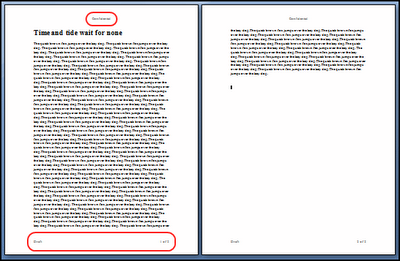
Way back in 2004, a project I was working on required a web page to be exported as a Word document (.DOC). Without relying on any components, I utilized the Office XML & HTML technique to implement this feature. I posted my sample on CodeProject to seek feedback. Over the years, I've received some generous comments & feature requests. Many wanted to know how to add a header & footer to the dynamically generated Word document. With the help of the Microsoft Office HTML and XML Reference , I devised a hack to add a lacklustre header and/or footer . Some folks wanted to customize the contents of the header & footer but when they tried with my hack that offered limited functionality, the header/footer text showed up in the document body to their annoyance. This July, an ingenious developer posted a hack that can overcome this problem, in the Comments section of my CodeProject article. His practical workaround was to pack the duplicating header/footer text inside a t...
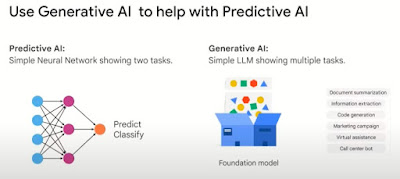
Traditional Predictive AI-ML is not going away and AI Capabilities & tools are evolving - Predictive AI Regression & Classification Forecasting Sentiment Analysis Entity Extraction Object Detection Generative AI Text, Image & Code Generation Text & Code Rewriting & Formatting Summarization Extractive Q&A Image & Video Descriptions Multimodal Generative AI Natural Image Understanding Video Question Answering Automatic Speech Recognition & Translation Spatial Reasoning and Logic Mathematical Reasoning in Visual Contexts Generative AI can also synthesize data to enhance a predictive model's training set to improve predictive capabilities. If the limit to a better model is more data, artificial datasets can be created that can train AI without compromising privacy or relying on scarce real-world data. From Current state of Generative AI Also see: Generative AI for Predictive Analytics A 15-day email course on Generative AI

Comments
Post a Comment