This Week I Learned - Week 47, 2026
This Week I Learned -
* Insights from the book Messy Jobs: The Work That AI Cannot Reach:
Wages are not decided by productivity but by scarcity. Each revolution moves what is scarce to another place.
Revolutions have also had various impacts on demand. Food got cheap, but people eat only so much. Better engines made power cheap. More uses, so more coal, not less.
The pace of automation is not set by capability alone. Once the technology works, two things buy time, not survival.
1. Demand for a human - would you still pay a premium to have an operator in the lift?
2. Regulation - who is liable when it goes wrong?
And even if regulation allows it and there is no human premium, three technical obstacles remain for A1 at today's capabilities
1. Verifiability - can anyone cheaply check the output?
2. On-the-job learning - does the work improve with experience?
3. Physical presence - does someone have to be there?
Four reasons AI cannot hold authority:
1. Tacit knowledge - people confide in a boss after years of trust; AI will struggle to access this
2. Liability - who answers in court when it is wrong?
3. Procedural fairness - people must accept the process, not just the answer
4. Human override - who can overrule AI? Why would AI obey? AI has nothing at stake over the long term
The human premium is a new scarcity in a world of abundance. The premium holds if human origin is:
- verifiable - you can tell a human did it
- perceptible - you feel the difference
- expressive - it says something about you
Why it is AI adoption slow inside companies
1. Architectural change - starting small fails: many changes must happen together
2. Fog - nobody knows the new way to work with AI yet
3. Resistance - those who stand to lose create friction, passive or active
- excerpts from Thomas Wolf's summary
* SpaceX's AI platform Cursor is reportedly considering discontinuing Chinese AI models because of geopolitical risks.
* IBM is discontinuing U.S. visa and green card sponsorship for most roles in its consulting business, its largest division with over 1.5 lakh employees, a move that will also severely impact Indian staff at the global tech giant.
* According to a study in Nature, not everyone with excess body fat faced the same health risks.
Even though the BMI cannot distinguish between the sources of body weight, it quickly became the principal measure used to classify obesity. A high value could reflect greater muscle or bone mass rather than excess body fat.
In 2025, the journal The Lancet Diabetes & Endocrinology established a commission of 58 experts from different countries to set obesity-related guidelines. Their main goal was to separate the two questions that had historically been treated as one: how to determine if a person has excess body fat, and is that excess fat actually impairing their health? The commission proposed 18 diagnostic criteria for clinical obesity in adults, covering dysfunction in various organs and tissues as well as significant limitations in everyday activities.
Some people with excess adiposity maintain normal organ function while others develop conditions such as type 2 diabetes, heart or kidney problems.
* 159 years after Darwin's book 'On the Origins of Species' was published, the Nobel Prize in Chemistry was awarded to Frances Arnold, Gregory Winter and George Smith who took control of evolution and used it for purposes that bring the greatest benefit to humankind.
Enzymes produced through directed evolution are used to manufacture everything from biofuels to pharmaceuticals. Antibodies evolved using a method called phage display can combat autoimmune diseases and in some cases cure metastatic cancer.
* How safe is packaged drinking water? - According to the FSSAI, a sample of packaged drinking water collected from Bisleri’s premises was found to be non-compliant with the prescribed limits for “bromate” and was declared unsafe under the Food Safety and Standards Act, 2006.
Bisleri has 143 plants across the country. According to Bisleri, the matter related to a batch manufactured in September 2025 at its Goa facility and maintained that its water was safe for consumption.
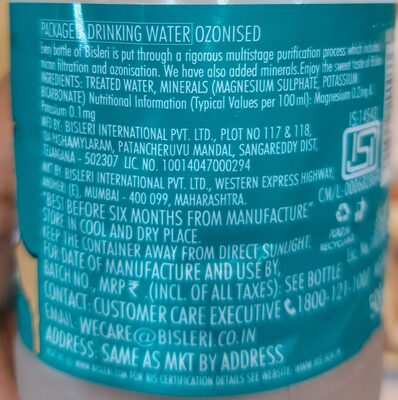
In 2023, bottled water was the principal source of drinking water for 15% of urban and 6% of rural households, as per Data For India. For consumers buying it at railway stations, airports, highway eateries and neighbourhood shops, a sealed bottle is often taken as an assurance of safety. Yet, the data submitted in Parliament in February 2025 revealed that 333 of 1,300 enforcement samples of packaged drinking water tested in 2023-24 failed to meet prescribed standards. Regulatory frameworks to include routine testing for microplastics and plastic-derived contaminants are currently absent in FSSAI and BIS standards. - The Hindu
* The Open Food Facts India database lists 35+ bottled water brands. FSSAI has quite a job to check whether packaged drinking water is safe for millions of consumers.
* Gemini gyan - Hikikomori means literally "pulling inward" or "being confined" in Japanese. It is better understood as acute social withdrawal and self-protection rather than an ideological rejection of society.
While outsiders often mistake it for rebellion, laziness, or misanthropy, clinical psychologists and sociologists studying the phenomenon (originally coined by Japanese psychiatrist Tamaki Saitō) emphasize that most hikikomori are not rejecting society out of disdain—they feel rejected by, overwhelmed by, or unable to meet society's rigid expectations.
In societies with rigid life scripts (where graduating on time, securing a prestigious job, and maintaining social harmony are treated as moral obligations), stepping off the expected track carries heavy stigma. Retreat behind a bedroom door becomes a psychological defense mechanism to avoid constant judgment from family, peers, and strangers.
* Food waste accounts for an estimated 8–10% of global greenhouse (more than trains and planes and the 3rd largest emitter after the USA and China) gas emissions, and around 60% of it happens at home.
The evidence-backed book Planetable by expert nutritionist and biomedical scientist Laurentia Campbell reveals the hidden nutritional power of foods we often throw away, that can promote health, save money, and help protect our planet!
* Akshaykalpa has stopped its organic bananas business because of grading and rejection losses of up to 50% arising out of customer preferences around ripeness and inconsistent sizes.
* Only 34 of 590sqkm or 5.8% of Hyderabad is green. Seoul has 5.2 times Hyderabad's share of green space. The two cities have similar land area, at the same scale. Seoul is 2.5 times more populated than Hyderabad.
In London which has comparatively lesser area (1,572 km²) and population (~9.12 million) than Hyderabad (2,053 km², 13.4 million), 97% of commuters rely on public transport, supported by a fleet of 9,000 buses that carry more passengers than the underground metro
* "The bottom 99% are subject to the law and not protected by it. And the top 1% are protected by the law but not subject to it." - Prof. Scott Galloway


Comments
Post a Comment