Posts

Showing posts with the label ML

This Week I Learned - Week 5 2026

Image
This Week I Learned -  *  Bananameter – A tutorial on building a machine learning model to identify the ripeness of a banana using images. Created with Teachable Machine, a web-based tool that makes developing machine learning models quick, simple, and accessible to all. *  MedGemma is a collection of Gemma 3 variants that are trained for performance on medical text and image comprehension. Kaggle's latest hackathon invites developers to use MedGemma and other open-weight models from Google’s Health AI Developer Foundations (HAI-DEF) to build human-centered AI applications for clinical environments that can’t rely on large, closed systems that require constant connectivity or centralized infrastructure.  * AI GuruSpeak -  "I've never felt this much behind as a programmer. The profession is being dramatically refactored as the bits contributed by the programmer are increasingly sparse and between. I have a sense that I could be 10X more powerful if I just pro...

This Week I Learned - Week #32 2025

Image
This Week I Learned -  * OpenAI's open weight models gpt-oss 20B and gpt-oss 120B support advanced reasoning and tool use. Open models are more easily customizable to build AI that can reason over your enterprise data and domains, providing a powerful option alongside proprietary models. gpt-oss can be used alone or alongside models like GPT-4o, Claude, or Llama. Built with a Mixture of Experts architecture gpt-oss delivers low-latency performance for use cases like search, chat, and real-time decisioning. It features a 131k context for long documents and RAG and it is provided under an Apache 2.0 license. * A typical software-application startup that’s not involved in training foundation models might spend 70-80% of its dollars on salaries, 5-10% on rent, and 10-25% on other operating expenses (cloud hosting, software licenses, marketing, legal/accounting, etc.).   Many of Meta’s properties rely on user-generated content (UGC) to attract attention, which is th...

This Week I Learned - Week #18 2024

Image
This Week I Learned -  * IBM has bought HashiCorp. HashiCorp Cloud Platform (the hosted Terraform, Vault, etc that HC manages themselves, their nominal secret sauce) runs on AWS today. * Venture capital firm Sequoia estimated that the AI industry spent USD50 billion on Nvidia chips used for training advanced AI models last year. But, in return brought home only USD3 billion in revenue – a concerning cost-to-profit ratio. - ET *  Teachable Machine is a web-based tool that makes creating machine learning models fast, easy, and accessible to everyone. The first version of Teachable Machine from 2017 can be used if you just want to quickly demo how machine learning works and don’t need to save anything. *  Google Family Link is a parental controls app that helps you keep your family safer online. If you're a parent, you can find your child's Android device location in Family Link once device location sharing is turned on. *  Sticker Mule 's Trace tool can e...

The MAD (ML, AI & Data) Ecosystem

Image
Matt Turck and his team have identified 2,011 organizations that make up the 2024 "ML, AI & Data" (MAD) Landscape in their annual industry report. The report notes that  MAD (ML, AI & Data) ecosystem  has gone from niche and technical, to mainstream. Check the  PDF & interactive version of the 2024 MAD Landscape. The overall structure of the landscape has the following sections - Infrastructure Open Source Infrastructure Data Sources & APIs Machine Learning & Artificial Intelligence Analytics Applications - Enterprise Applications - Horizontal Applications - Industry Data & AI Consulting DataCamp also has an infographic about the Generative AI Tools Landscape in 2023 . Also see -  Ecosystem Landscape Diagrams

A 15-day email course on Generative AI

Image
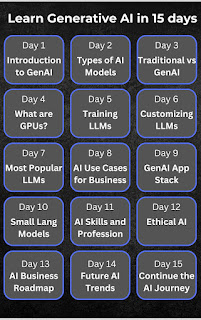
The  15-day Generative AI email course by Armand Ruiz , Director of AI at IBM, provides bite-sized lessons on essential topics. Whether you're new to Generative AI or desiring an informative refresher, this course maps out the key terms and ideas you need through sticky content and visuals. An index of all the keywords referenced in the series: Artificial General Intelligence (AGI) Artificial Intelligence AI Engineer Auto-GPT  Base model BERT  Chatbots ChatGPT Chinchilla Classification  Content Generation Conversational AI  Convolutional Neural Network (CNNs)  Data Scientist Deep learning Diffusion  Discriminative Models EleutherAI Embeddings Fine Tuning Few-Shot Prompting Foundational model Generative AI Generative Adversarial Network (GAN)  Generative Models Generative Question-Answering (GQA). GPT  Granite  Graphics Processing Unit (GPU) Hyperparameters Insight Extraction LaMDA LangChain Large Language Model (LLM) Llama Low-Rank ...

This Week I Learned - Week #49 2023

Image
This Week I Learned -  *  Streamlit is an open-source app framework for Machine Learning and Data Science teams *  FoodData Central is an integrated data system that provides expanded nutrient profile data and links to related agricultural and experimental research. It provides nutrition data of ~500K branded food products. The FoodData Central API provides REST access to FoodData Central (FDC). USDA FoodData Central data are in the public domain and they are not copyrighted. They are published under CC0 1.0 Universal (CC0 1.0) * Gemini succeeds PaLM 2, the current foundation model from Google. * Internal tests showed that Q, Amazon's AI-powered assistant that enables employees to query documents and corporate systems, could leak confidential information from Amazon such as internal discount programs, unreleased features, and locations of AWS data centers. Amazon spokespeople called such scenarios hypothetical and denied that Q had leaked such information. Amazon ...

This Week I Learned - Week #48 2023

Image
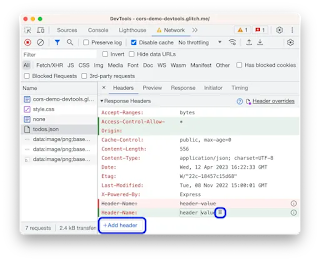
This Week I Learned -  * HTTP/3 builds on the foundations laid by HTTP/2 but introduces significant changes, primarily by shifting from TCP (Transmission Control Protocol) to QUIC (Quick UDP Internet Connections) as the underlying transport protocol. - The Valley of Code * From the Chrome Developer Tools Network panel, you can override HTTP response headers and web content , including XHR and fetch requests, to mock remote resources even if you don't have access to them or the web server. * A VSIX package is a .vsix file that contains one or more Visual Studio extensions, together with the metadata Visual Studio uses to classify and install the extensions.  *  Replicate lets you run machine learning models with a few lines of code, without needing to understand how machine learning works. *  Chatbot Arena lets you chat with any two models among these side-by-side: GPT-3.5: GPT-3.5 by OpenAI GPT-3.5-Turbo-1106: GPT-3.5-Turbo-1106 by OpenAI GPT-4-Turbo: GPT-4-T...

This Week I Learned - Week #47 2023

Image
This Week I Learned -  * The Applied Skills assessment lab gives you the opportunity to demonstrate your skills by completing tasks in the associated technology, such as Azure, Microsoft 365, or Power Platform.  You will perform tasks in a virtual environment.  Most Microsoft Applied Skills assessment labs for a given scenario typically contain 12-16 tasks; however, the number can vary depending on the skill domain being assessed. You will have 2 hours to complete the lab with the ability to request an additional hour if needed as you progress through the lab. For most Applied Skills credentials, you’ll be informed of your results within minutes, but it can take up to 24 hours for results to appear in your Learn profile’s Credentials tab.  *  Amazon Elastic Compute Cloud (Amazon EC2) UltraClusters can help you scale to thousands of GPUs or purpose-built ML accelerators, such as AWS Trainium , to get on-demand access to a supercomputer. They democratize ac...

This Week I Learned - Week #46 2023

Image
This Week I Learned -  * PartyRock is a fun way to learn the fundamentals of foundation models and then collaborate with other developers. Anyone can access PartyRock through the website, and you don’t need an Amazon Web Services (AWS) account. PartyRock uses foundation models from Amazon Bedrock to turn your ideas into working PartyRock apps. You don't need to be a developer or ML engineer to start creating your own apps. Just write a text-based prompt to describe what you want your app to do in the PartyRock app builder. * Amazon Bedrock is a fully managed service that makes foundation models (FMs) from Amazon and leading AI companies available on AWS available through an API. It is the easiest way to build and scale generative AI applications with foundation models. PartyRock provides builders with access to FMs from Amazon Bedrock in a code-free app-building playground to learn the fundamentals of prompt engineering and generative AI. *  Virtual Assistants (VA)...

This Week I Learned - Week #45 2023

Image
This Week I Learned -  * The  user-select:none style can block a user from selecting text - body{-webkit-user-select:none;-moz-user-select:-moz-none;-ms-user-select:none;user-select:none} * Pangrams are sentences that have all 26 letters of the alphabet in them.  Codepo8 has written a Pangram Checker to write pangrams and check them while typing.  * ScyllaDB is a NoSQL data store compatible with Apache Cassandra that runs on top of Seastar. Discord migrated trillions of messages from Cassandra to ScyllaDB. The book Database Performance at Scale written by engineers at Scylla, covers strategies for achieving low latencies at high throughput. Scylla is the new name of the Israeli startup Cloudius Systems that is behind ScyllaDB. *  GitHub Skills is a collection of interactive courses on how to use GitHub designed for beginners and experts. *  Jupyter AI brings generative artificial intelligence to Jupyter notebooks, giving users the power to explain an...

Notes: How to Build a Career in AI eBook

Image
How to Build a Career in AI is a 41 page ebook with great insights, advice and suggestions from Andrew Ng, the founder of DeepLearning.AI and Coursera. Highlights and excerpts: Keeping up-to-date with changing technology is more important in AI than fields that are more mature. The highly iterative nature of AI projects leads to special challenges in project management: How can you come up with a plan for building a system when you don’t know in advance how long it will take to achieve the target accuracy? Even after the system has hit the target, further iteration may be necessary to address post-deployment drift. Exploratory Data Analysis (EDA) — using visualizations and other methods to systematically explore a dataset — is particularly useful in data-centric AI development. The best way to build a new habit is to start small and succeed, rather than start too big and fail.  Five steps to help you scope projects: Identify a business problem (not an AI problem). Ask - “What ar...

This Week I Learned - Week #41 2023

Image
This Week I Learned -  *  Kaggle's 2023 AI Report is a collection of 20+ essays written by Kaggle community members covering the latest AI advancements and salient topics in modern ML. *  Digital Rights Management (DRM) is technology that enables online video and audio services to enforce that the content they provide is used in accordance with their requirements. This technology may restrict some of the things you can do in the browser. Many services are moving towards HTML5 video that requires a different DRM mechanism called a Content Decryption Module (CDM).  * Firefox for desktop supports the Google Widevine CDM for playing DRM-controlled content. Firefox downloads and enables the Google Widevine CDM by default to give users a smooth experience on sites that require DRM. The CDM runs in a separate container called a sandbox, and you will be notified when a CDM is in use.  *  Lossless Cut is probably the simplest way to cut out parts of a video withou...