Posts

Showing posts with the label ServiceFabric

Capacity limits of resources within Azure Service Fabric
Image
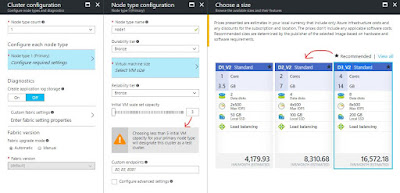
Unlike most Azure PaaS services, there is no charge for the Service Fabric service itself but the final cost of creating the Service Fabric clusters & running them has to be calculated on your own. A  minimum of the following IaaS resources are at least created for you: Virtual Machine Scaleset Public IP address Virtual Network Load Balancer Storage accounts I was curious to know what are the minimum and maximum capacities you can have for the cluster components so I monkeyed around the Service Fabric blades click image to enlarge Node types can be seen as equivalent to roles in cloud services. In each node type you can define the VM sizes, the number of VMs, and their properties. A Service Fabric cluster must have at least one node type and upto 3 in a cluster. Durability tier determines the SKU size for your node type. The default Bronze tier supports Standard_A/D/DS SKUs. Gold tier supports G5 as the largest VM type possible if available in chosen re...

Comparison of App Service, Cloud Services, Virtual Machines, and Service Fabric

As part of my learning, I keep looking out for info presented through tables & comparison charts as they  summarize lengthy topics &  are useful to review what I learn. I post them with the tag  ComparisonChart  to revisit occasionally. The following table compares the capabilities of App Service, Cloud Services, Virtual Machines, and Service Fabric (follow the link for any updated info): Feature App Service (web apps) Cloud Services (web roles) Virtual Machines Service Fabric Notes Near-instant deployment X X Deploying an application or an application update to a Cloud Service, or creating a VM, takes several minutes at least; deploying an application to a web app takes seconds. Scale up to larger machines without redeploy X X Scale out to multiple instances without redeploy X X X X Virtual Machines can scale out to multiple instances, but the services running on them must be written to handle this scale-out. You have ...