Posts

Showing posts with the label Containers

This Week I Learned - Week #19 2022

Image
This Week I Learned -  * Crisp article comparing Azure Container options :  Azure Container Apps (Preview) Azure App Service Azure Container Instances Azure Kubernetes Service Azure Functions Azure Spring Cloud Azure Red Hat OpenShift *  Both Linux and Windows containers are supported in Service Fabric since 2017 . *  Enterprise customers prefer to have a “golden” image (an image that meets all their organisational requirements) that they can reuse when deploying additional VMs than deploy additional VMs and then run a provisioning script post-deployment. Reusing an image makes scaling out faster and more reliable while keeping you in policy. And once you have the process in place to build images, you can easily rebuild them regularly to include OS and application updates. But creating and managing your own image pipeline to build those custom images means running extra infrastructure and managing extra software. Azure Image Builder offers you that as a cloud s...
This Week I Learned - Week #44 2020

Image
This Week I Learned -  *  Azure Backup uses Geo-redundant storage (GRS) by default. * Azure Backup can install a  workload backup extension  on a SQL Server instance on Windows to support Full, Differential,  Transaction log backup options. SQL Server on Linux does  not  currently integrate with Azure Backup. * Only Microsoft Azure Backup Server (MABS) or System Center Data Protection Manager (DPM) support app-aware backups. * A snapshot is a point-in-time backup of all disks on the virtual machine. For Azure virtual machines on Windows, Azure Backup uses VMSnapshot extension while VMSnapshotLinux extension is used on Linux * The Azure Backup pricing for VMs is based on the size of the backed-up data, because the cost is based on the size of the allocated disk space. For SQL Server backups, cost is based on the size of the database backup file. *  Azure Backup offers the ability to back up virtual machines encrypted with Azure Disk Encry...

Multicloud Container Development Platforms

According to the Forrester Wave evaluation of 8 Multicloud Container Development Platforms (MCDP) ,  Red Hat-IBM, Google, and Rancher are Leaders; VMware, D2iQ, and Platform9 Systems are Strong Performers;  Mirantis and Canonical are Contenders. Dev experience, distributed operations & ecosystem integrations are the key differentiators that set apart the  platform providers

This Week I Learned - Week #41 2020

Image
This Week I Learned -  *  20+ best practices to set up networking for workloads migrated to Azure *  Advisor Score measures how well you’re adopting Azure best practices, comparing and quantifying the impact of the Advisor recommendations you’re already following, and the ones you haven’t implemented yet. Think of it as a gap analysis for your deployed Azure workloads. Advisor Score provides customers with a prioritized list of recommendations specifying the exact impact an individual recommendation will have on their overall score. This helps customers overcome “recommendation fatigue” with a unifying system to compare and prioritize recommendations and gives customers the ability to track their progress over time. * Both load balancer & reverse proxy sit between clients and servers, accepting requests from the former and delivering responses from the latter. Whereas deploying a load balancer makes sense only when you have multiple servers, it often makes ...

This Week I Learned - Week #34 2020

Image
This Week I Learned -   * If you want to have full control of the management and scheduling of your clusters of VMs rather than using the services provided through Azure Batch, consider using  HPC Pack which offers a series of installers for Windows that allows you to configure your own control and management plane, and highly flexible deployments of on-premises and cloud nodes. By contrast with the exclusively cloud-based Batch, HPC Pack has the flexibility to deploy to on-premises and the cloud. It uses a hybrid of both to expand to the cloud when your on-premises reserves are insufficient. *  Kubernetes has also become the universal control plane for orchestrating , not just containers but also a variety of resources, including virtual machines, databases, and even SAP Hana instances. *  AKS is " cheaper than running your own kubernetes distribution in Azure ! If you know that the kubernetes code base has changed for about 97% in the last three years, you ca...

This Week I Learned - Week #291

This Week I Learned - *  Azure Reservations helps you save money by pre-paying for one-year or three-years of virtual machine, SQL Database compute capacity, Azure Cosmos DB throughput , or other Azure resources. * As with other managed disks, Standard SSD is stored in triplicate on Locally-Redundant Storage (LRS). The disks are designed to have 99.999% availability * Containers are designed to be stateless and changes made to the container are sandboxed and they do not affect the container host. Unlike VMs, containers do not provide hardware virtualization. Instead, they provide virtualization at the operating systems level. Containers share portions of the host operating system kernel which is why Windows containers are limited to Windows hosts and Linux containers can only run on Linux hosts. However, recent changes in Windows Server container support include using a small specialized Linux VM to enable the running of Linux containers on Windows hosts. A contain...

Notes from Pluralsight course "Docker and Containers: The Big Picture"

The Pluralsight video course Docker and Containers: The Big Picture by Nigel Poulton provided a good introduction but I found it to be needlessly long Key points from the 1hour 47minute course released in 22 Dec 2015 - Container is a standardized unit of software Open Container Initiative is responsible for Container format and runtime standards Docker and containers can handle stateful and stateless workloads Docker storage backend is pluggable Docker containers are peristent Stopping a container doesn't wipe its data. Restarting a container brings its data back Container data stored in volumes persists even after the container is destroyed Container Registries are places to store & retrieve container images Docker Hub is the official Docker Registry Registries contain Repositories Registries are the enterprise IT App Store Repositories can be public or private Public repositories are open for pulling (downloading) but not for pushing (uploading changes) Doc...

Options for running Containers in Azure

Options for running Containers in Azure: Azure Container Service: Scale and orchestrate containers using Kubernetes, DC/OS or Docker Swarm Azure Container Instances: Easily run containers on Azure with a single command Azure Service Fabric: Develop microservices and orchestrate containers on Windows or Linux Web Apps for Containers: Deploy web applications on Linux using containers Azure Batch: Run Linux container workloads -  samples on GitHub showing how to integrate Docker with Azure Batch Further reading: Which Azure Deployment Model Should You Use? 4 Ways To Deploy Dockerization of Azure PaaS (Beyond Azure Container Service) Difference between Azure Container Services (ACS), Azure Service Fabric (ASF) and Azure Functions (AF) and when to use what Service Fabric vs Azure Container Service - Part 1: Introduction Difference between Azure Container Service and Web App for Containers Github sample demonstrating how to create a multi-container application using...

This Week I Learned - Week #207

Image
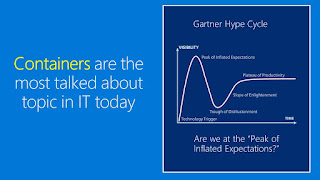
This Week I Learned - * With the availability of Geographic Routing capability in Azure Traffic Manager, you can now direct user traffic to specific endpoints based on the geographic location from where the requests originate. As an example, an e-commerce site can localize the site content and merchandise items to users in a specific region. Knowing where the users are coming from makes it easier to implement mandates related to data sovereignty - Azure Blog *  Kubernetes Pod is a group of one or more containers that are always co-located, co-scheduled, and run in a shared context *  Gartner's Hype Cycle, attempts to capture the perceptions and reality of a given technology. Technologies typically undergo a period of inflated expectations, only to be followed by a downward slope into the trough of disillusionment, whereby the promises of the technology fall short of reality. At some point, a realistic perception of the technology gains momentum and technologists become...