Posts

Showing posts with the label DevOps

GitHub Actions Certification Exam - Learning Resources

Image
GitHub Actions Certification Exam (GH-200)  is designed for DevOps engineers, software developers, and IT professionals with intermediate-level experience in GitHub Actions, including workflow creation, automation, and CI/CD pipeline management. This exam covers: Streamlining workflows Automating tasks Optimizing software pipelines Study Notes: MS Learn - Automate your workflow with GitHub Actions GitHub Actions: Beginner to Pro From the video "GitHub Actions: Beginner to Pro" course notes Practice tests: MS Learn Practice assessment GHCertified  (127 questions) Video Tutorials: 5-part series, Jan 2026 Instructor: Rob Foulkrod Course Introduction Introduction to Actions  Pipelines in GitHub Actions Extending Workflows Organization and Enterprise Configurations Instructor - Sid Palas, 24 Sept 2025 Duration - 3h 42m  Instructor - Andrew Brown, 7 May 2024 Duration - 3h 10m  AZ-400: Design and Implement Microsoft DevOps solutions, March 2026 Instructor:...

Generative Culture

Image
SRE adoption is greatly influenced by the organizational culture at hand. Westrum organizational culture is one of a set of capabilities that drive higher software delivery and organizational performance. These capabilities were discovered by the DORA State of DevOps research program , an independent, academically rigorous investigation into the practices and capabilities that drive high performance. Similar to Dr. Westrum's findings, DevOps Research and Assessment (DORA) research shows that a high-trust, generative culture predicts software delivery and organizational performance in technology. Teams can identify helpful practices to create a generative culture that fosters information flow and trust by examining the six aspects of Westrum's model of organizational culture, focusing on those behaviors seen in the generative culture: High cooperation. Messengers are trained. Risks are shared. Bridging is encouraged. Failure leads to inquiry. Novelty is implemented. Related: SR...

This Week I Learned - Week #3 2023

Image
This Week I Learned -  * Cloud Foundry is an open-source platform-as-a-service (PaaS) for building, deploying, and operating 12-factor applications developed in various languages and frameworks. There are two forms of Cloud Foundry available to run on Azure : open-source Cloud Foundry (OSS CF) and Pivotal Cloud Foundry (PCF). OSS CF is an entirely open-source version of Cloud Foundry managed by the Cloud Foundry Foundation. Pivotal Cloud Foundry is an enterprise distribution of Cloud Foundry from Pivotal Software Inc. which is now acquired by VMware. It is now called Tanzu Application Service (TAS). VMware is transitioning from Cloud Foundry to Tanzu tools and nomenclature. * Free ebook -  Azure SQL Revealed: A Guide to the Cloud for SQL Server Professionals ;519 pages, 2021 *  Terraform Workshop slides *  OpenStack began as a joint project between Rackspace and NASA .   *  OpenStack is an open source platform that uses pooled virtual resources t...

Terraform - Highlights

Image
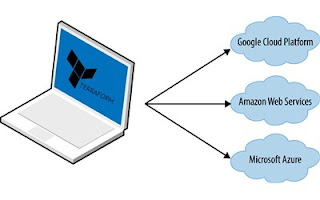
Terraform is an open-source, infrastructure as code , software tool created by HashiCorp.  It lets you define both cloud and on-prem resources in human-readable configuration files that you can version, reuse, and share. You can then use a consistent workflow to provision and manage all of your infrastructure throughout its lifecycle. Terraform uses declarative configuration to describe the desired final state.  Once a user invokes Terraform on a given resource, Terraform will perform CRUD actions on the user's behalf to accomplish the desired state .  The infrastructure as code can be written as modules , promoting reusability and maintainability. Terraform manages external resources (such as public cloud infrastructure, private cloud infrastructure, network appliances, software as a service, and platform as a service) with " providers ".  HashiCorp maintains an extensive list of official providers and can also integrate with community-developed providers. Publish ...

This Week I Learned - Week #16 2022

Image
This Week I Learned -  * Amazon Aurora is a MySQL and PostgreSQL-compatible relational database built for the cloud, that combines the performance and availability of traditional enterprise databases with the simplicity and cost-effectiveness of open source databases. Amazon Aurora is up to five times faster than standard MySQL databases and three times faster than standard PostgreSQL databases. It provides the security, availability, and reliability of commercial databases at 1/10th the cost. Amazon Aurora is fully managed by Amazon Relational Database Service (RDS), which automates time-consuming administration tasks like hardware provisioning, database setup, patching, and backups. *  TimelineJS is an open-source tool that enables anyone to build visually rich, interactive timelines.  * Children and youth today are surrounded by artificial intelligence (AI) in their everyday lives – from social media to smart speakers and toys, video games, and even education technolo...

Condensed Transcript of "Designing a Secure Cloud-Native Architecture using Kubernetes on Azure"

Image
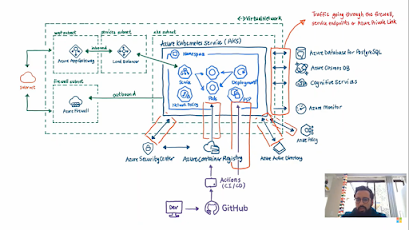
Condensed transcript of Ahmed Sabbour’s talk on Designing a Secure Cloud-Native Architecture using Kubernetes on Azure : Let’s say you want to create an application and to deploy this to the Cloud and you decided to adopt container technology. So how do we actually get started? As a developer, you have your code your developing on your local machine. Then you push this source code to some source control repository for good measure, whether that’s GitHub or somewhere else, you just do that. GitHub Actions makes it easy to automate & kick off workflows with GitHub events like push, issue creation, or a new release. Actions are individual tasks that you can combine to create jobs and customize your workflow. You can set up some CI/CD process, a continuous integration and continuous deployment process on top of that to actually build, take that code, and build this using the CI/CD process into a container image, which then gets pushed into a container registry or a non-image repo...

This Week I Learned - Week #31 2020

Image
This Week I Learned -  * Windows Server container support in the Azure Kubernetes Service makes it possible to: - Lift and shift Windows applications to run on AKS - Seamlessly manage Windows and Linux applications through a single unified API - Mix Windows and Linux applications in the same Kubernetes cluster – with consistent monitoring experience and deployment pipelines *  Helm Charts helps you define, install, and upgrade even the most complex Kubernetes application. The latest version of Helm is maintained by the CNCF – in collaboration with Microsoft, Google, Bitnami and the Helm contributor community. * Azure disk encryption (ADE) that leverages the BitLocker feature of Windows and the DM-Crypt feature of Linux to encrypt Managed Disks with customer managed keys within the guest virtual machine * Temporary disks are not managed disks and are not encrypted by SSE   * Cloud Native Computing Foundation ( CNCF ) runs the Certified Kubernetes Conformance Program. Ther...

Comparison of Infrastructure as Code tools

Image
Source - Multiple articles by   Yevgeniy Brikman  & other online articles : Source Cloud Type Infrastructure Language Agent Master Community Maturity Initial Release Chef Open All Config Mgmt Mutable Procedural Yes Yes Large High 2005 Puppet Open All Config Mgmt Mutable Declarative Yes Yes Large High  2009 Ansible Open All Config Mgmt Mutable Procedural No No Large Medium  2011 SaltStack Open All Config Mgmt Mutable Declarative Yes Yes Medium Medium  2011 CloudFormation Closed AWS Provisioning Immutable Declarative No No Small Medium 2012 Heat Open All Provisioning Immutable Declarative No No Small Low  2012 Terraform Open All Provisioning Immutable Declarative No No Medium Low  2014 Deployment Manager GCP Config Mgmt Declarative   2015 Pulumi Open All Provisioning Immutable Declarative  2017 The...

Azure in Pictures: Windows VMs for an application with N-tier architecture

Image
Architecture diagram source:  Running Windows VMs for an N-tier architecture on Azure Elements of the architecture diagram: - Availability sets. Create an availability set for each tier, and provision at least two VMs in each tier. This is required to reach the availability SLA for VMs. - Subnets. Create a separate subnet for each tier. Specify the address range and subnet mask using CIDR notation. - Load balancers. Use an Internet-facing load balancer to distribute incoming Internet traffic to the web tier, and an internal load balancer to distribute network traffic from the web tier to the business tier. - Jumpbox. Also called a bastion host. A secure VM on the network that administrators use to connect to the other VMs. The jumpbox has an NSG that allows remote traffic only from public IP addresses on a safe list. The NSG should permit remote desktop (RDP) traffic. - NSGs. Use network security groups (NSGs) to restrict network traffic within the VNet. For example,...

Learning resources on DevOps with Azure

Image
slide from DevOps Introduction Update 10/Sep/16 - This comprehensive cheat sheet maintained by Julien Stroheker  written after I started compiling my list has a lot of useful learning material. * The level 300 video course Deep Dive into Azure Resource Manager Scenarios and Patterns  on MVA, published on 01 October 2015 has well-organized content on ARM. The way the presenters run into an unexpected failure during the demo in episode 3 and then go on to debug & investigate what went wrong was very educational. * DevOps Fundamentals  series on Channel 9 work in progress

List of DevOps practices

According to the IT Pro Guy, the following constitute fundamental DevOps practices : Infrastructure as Code (IaC) - is the practice in which the techniques, processes, and tool sets used in software development are leveraged to manage the deployment and configuration of systems, applications, and middleware. A significant number of testing and deployment defects occur when developers’ environments defining the application and underlying infrastructure differ from testing and production environments. Standardizing these environment definitions, putting them under version control, and deploying and configuring the infrastructure and application automatically from the code in version control, yields immediate benefits in consistency, time savings, error rates, and auditability. Continuous Integration (CI) - is the practice of merging all working copies of developers code with a shared mainline, producing a new build upon code check-in. Ideally CI also involves libraries...

TFVC vs Git, TFS vs VSTS

Image
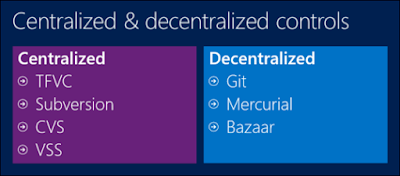
The MVA video course DevOps: An IT Pro Guide  (Level 300 | Published: 06 June 2014) comes with a great slide deck. The second part of the 5-part series compares TFVC vs Git, TFS vs VSTS (or Visual Studio Team Services, the new name for Visual Studio Online). Click on the images below for a slightly better view of the text or download the related  PowerPoint Presentation  for the slides. It is interesting to note that VSTS being a SaaS based product, the updates to TFS first appear in it before they appear in an installable copy of TFS. Related: *  Notes from the MVA course "Fundamentals of Visual Studio Online" *  Book Review: Pro Team Foundation Service