Posts

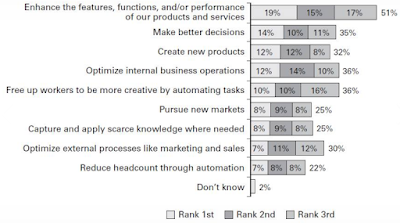
Benefits Sought from Cognitive Technologies
Image
“Cognitive technologies” include machine learning, deep learning neural networks, natural language processing, rule engines, robotic process automation, and combinations of these capabilities for higher-level applications. Benefits sought from Cognitive Technologies, by ranking according to a Deloitte “Cognitive Aware” survey - Enhance the features, functions, and/or performance of our products and services Make better decisions  Create new products Optimize internal business operations Free up workers to be more creative by automating tasks Pursue new markets Capture and apply scarce knowledge where needed Optimize external processes like marketing and sales Reduce headcount through automation

This Week I Learned - Week #290

This Week I Learned - * With Azure, you can build, deploy, and run container-based applications in the cloud or onpremises with a choice of leading open source tools and technologies, including Kubernetes, Docker Swarm, and DC/OS—all supported by Azure. Azure provides multiple options for your containerization strategy, including Azure Kubernetes Services (for containers as a service) and Web Application for Containers (for deploying containerized web apps). You also can directly deploy Azure Container Instances without having to provision any VMs - Expedition Cloud: inside Microsoft’s cloud migration and application development journey *  Site Recovery Deployment Planner is a command-line tool for both Hyper-V to Azure and VMware to Azure disaster recovery scenarios. You can remotely profile your VMware VMs by using this tool (with no production impact whatsoever) to understand the bandwidth and storage requirements for successful replication and test failover. * Red H...

Compared: AWS Virtual Private Cloud (VPC) vs Azure Virtual Network (VNet)

Similarities and differences between Azure VNets and AWS VPC from a Premier Developer blog post - AWS Virtual Private Cloud (VPC) Azure Virtual Network (VNet) Subnet Both Azure VNet and AWS VPC segregate the networks with subnets An AWS VPC spans all the Availability Zones (AZs) in that region, hence, subnets in AWS VPC are mapped to Availability Zones (AZs). A subnet must only belong to one AZ and cannot span AZs. Communications between all subnets in the AWS VPC are through the AWS backbone and are allowed by default. AWS VPC subnets can either be private or public. A subnet is public if it has an internet gateway (IGW) attached. AWS allows only one IGW per VPC and the public subnet allow resources deployed in them access to the internet. AWS creates a default VPC and subnets for each region. This default VPC has subnets for each region where the VPC resides, and any image (EC2 instance) deployed to this VPC will be assigned a public IP address and hence ha...